Thursday, September 16, 2021

THE DREADED CURSE OF IMPULSE BUYING

     They know how to sell us stuff we neither want nor need, but we buy anyway. It’s there, all spread out for us like a garden of delights. The trap is set. We have to pass by it. Or, worse, stand next to it while waiting our turn. 

     You probably know I’m talking about check-out lanes at just about any store. The disease they’ve learned to profit from is “impulse buying.” It happens so easily, attracts us so effortlessly. 

      Recently I was standing in line at Ace Hardware. I held a 2-pack of halogen light bulbs and a jar of gopher and mole poison pellets, “Guaranteed to rid my yard” of these burrowing creatures. Two people stood in front of me, so I kept my proper social distance. Next to me was an assortment of hard and soft candy in bars and bags, salty snacks, colorful bracelets, action figures with little or no action, small plastic animals, insulated cups…the variety was impressive. Like a mini-Woolworth’s. Remember, this was a  hardware store. Nails and screws and pliers I would have understood, but this was far out of the category of hardware.

     I’ve got to confess here. I am a sucker for temptation, a victim of suggestion, a consumer of the unnecessary. It usually manifests itself with a sudden need for sugar or salt or something crunchy or chewy.  Even an occasional gadget that I didn’t realize how badly I needed it until I saw it was “New, Tested, Guaranteed, and Essential.” Guaranteed for what, it didn’t say. Those people have my number.

 
     So I bought a bag of licorice tidbits at Ace, “soft, chewy, delicious.” They were made in New Zealand or somewhere not usually associated with licorice. Switzer’s I would’ve understood. I ate three pieces in the car, then pitched the bag into the trash can when I got home. I probably should have given them to the gophers and moles in my yard. That would have speeded them along to a soft, chewy death.


     The good people who design floor plans for retail stores most certainly keep a psychiatrist or two on staff. They have read us like a book, know what our weak spots are, and probably have a list of categories with projections of sales and inventory turnover. These are most certainly connected to the type of retail outlet in which they’ve been installed. Ace Hardware has different customer profiles from Best Buy, which are different from Schnuck’s and Walgreen’s and Bed, Bath and Beyond. Maybe those impulse items are what “Beyond” means. Further, they all seem to feature a wide variety of gum. Ever notice that? Every configuration of gum is displayed in this impulse purgatory. If you need to chew, you’ll find it here.


     Possibly the most fascinating category for me is the magazines. I have learned things about public figures I never see in the New York Times or Wall Street Journal. Just put me in a slow-moving line at checkout and I’ll be up-to-date on who’s getting a divorce or has a drug problem or is pregnant or has been messing around. I’m tired of reading about Prince Harry and Meghan and George Clooney and J. Lo and Ben and even Elvis. People I’ve never heard of fascinate me. Usually young celebrities who have gone viral for some unbelievable reason. It’s really hard not to read this stuff. Maybe that’s part of the reason reality TV shows are so popular. And I would know nothing about them if it weren’t for their accessibility at a vulnerable time. We’ve become a TikTok nation.     

     Impulse purchases are not relegated to just the checkout line, of course. If you go food shopping without a carved-in-stone shopping list, you’re guaranteed to put a few extra items in your cart. Recently I went to get a half-gallon of 2% milk. I got it, along with a half-gallon of Oatmeal milk (“Made with organic oats”) and a half-gallon of chocolate milk (“Omega-3 Supports Brain Health”). That sounded pretty good, but there’s no way I can drink them all before they expire. I will finish the chocolate milk however.

                             This column was published in the current issue of                                                     County Living Magazine (Fall 2021) 

Monday, June 28, 2021

The Serendipitous Effect of the Second Banana

That's a pretty heavy title. Here's why it's relevant. 

 I think another word for what happened is "synchronicity." That's when events - in this instance, two events - appear at the same time but there is no logical connection that might have caused it. Carl Jung came up with this concept. He was a pretty smart guy with some stimulating ideas about you and me and everyone else. 

    What I'm about to tell you could also be classified under the chapter called "Coincidence." That's an easy way to dismiss any deeper interpretation. We've all had those, right? Okay, enough preamble.

    I wrote a column recently for County Living Magazine. It was about Second Bananas. The title was "Whatever Happened to Those Second Bananas?" Maybe you read it in the magazine, or on this blog a couple weeks ago. Second Bananas is not a subject you see very often. The printed version of the magazine was due off the press, and I was waiting to get my copies.


Yesterday - a Sunday - I was reading the New York Times, deeply engrossed in the Arts and Leisure section. The lead article was "Saying Goodnight To the Sidekick." The subject was Andy Richter, who was the sidekick for Conan. He said his job is like a dog or goat who is paired with a horse to keep it calm. "I'm the goat," he said.

    Two more articles were inside that section. One had more about the various sidekicks, and one was titled "The Top Second Banana Moves On." That was about Richter. Captivated by the Second Banana headline, I was just starting to read that article when there was a knock at my door.  I opened the door and there stood Todd Abrams, the publisher and editor of County Living Magazine. In his hands he carried a stack of the latest edition, the one with my Bananas column. Todd believes in excellent personal service, which is one reason why his magazine is so professional and worthwhile.

    So there I stood, the Times in one hand, the magazine in the other. This was synchronicity of the first order. Jung would have said, "See? I told you." I showed Todd the newspaper. Not just to let him know how impeccable my timing had been, but to provide proof that such things still happen, even in this digital, distanced, techno world. Or, perhaps, maybe because of it. 

    Here's my suggestion to you: Keep your mind and heart open for connections you may never have guessed at, for unexpected meetings beyond your imagination, for a direct link to the forces that are out there. They are watching us, listening to us, and just waiting to connect us, if only we let them in.

    
Here is a link to the Second Bananas blog I posted in June.

http://heyyouhoser.blogspot.com/2021/06/whatever-happened-to-those-second.html


Sunday, June 13, 2021

Whatever Happened to Those Second Bananas

    I passed a diner recently in Washington, Missouri. Wimpy’s Sandwich Shop. I didn’t stop but the name stayed with me as I continued driving, headed back to St. Louis.

Wimpy. Here was one of the great characters of the comics, Popeye’s buddy. I assume Popeye is still around, in one media format or another. But Wimpy seems to have faded away, remembered only by his hamburgers. Frankly, I could never understand this duo: Popeye was energetic with big muscles and ate spinach from the can. Wimpy was overweight, wore ugly ties, picked up discarded cigars, and ate hamburgers. Still, they were buddies. Wimpy was Popeye’s straight man. He was the “Second Banana.”

    I love that designation: Second Banana. As compared to Top Banana. The term originated in burlesque as a designation for comedians. The Second Banana’s role was to make the Top Banana look good.

         That set me wondering about other forgotten or discarded Second Bananas. I’m sure you know Porky Pig. But do you remember his girl friend? If you said “Petunia,” you win a pound of bacon. Introduced in 1937 by animator Frank Tashlin at Warner Brothers, Petunia went from co-star to minor roles to a discarded has-been several years later. A sad story indeed. I think Porky had feelings for her, but wonder if he still thinks of his lost love. I hope Petunia has found happiness playing bridge or bingo with friends at a pig-friendly retirement facility.

    Minnie Mouse fared much better. Maybe because Disney had a more compassionate heart than Jack Warner. I was not a big fan of Minnie but was pleased to learn that she and Mickey got married, in 1933. Unfortunately it didn’t happen on-screen. But Walt attested to their tying the knot, off-screen. Seemed the American thing to do back in those days. I’m still waiting for news of their children. Assuming they had them. Mice are prolific.
   

One of my personal favorites in the Disney stable is Donald Duck. He has an edgy, out-of-control personality that I appreciate. It took a special woman to love him. Her name was Daisy, who appeared in 1940. I’m happy to report that Daisy continues to enjoy a film career, and is still married to Donald. All’s well that ends well, even in Duckville.
    Other Second Bananas come to mind: Robin (Batman), Elmer Fudd (Bugs Bunny), Barney (Fred Flintstone), BooBoo (Yogi Bear), Tigger (Pooh). And the list goes on. My apologies if I’ve omitted your favorite. They all helped further the careers of the Top Bananas but somehow got lost in the dust of memory and competition.


    Which brings me to a most interesting group of Second Bananas - the Seven Dwarfs.

When Snow White met these little guys, they assumed an important role in this beloved story, made popular by Disney in 1937. But how did it all end? Snow White and The Prince get together and ride into the sunset on a magnificent steed, leaving behind her seven little friends. “So long, it’s been good to know ya.”? Sorry, Snow. Not acceptable.

    For the record, their names (to refresh your memory) are: Happy, Bashful, Sneezy, Grumpy, Doc, Sleepy and Dopey. Those were the names Walt gave them anyway. In the original story of Snow White, the Brothers Grimm didn’t name the little fellows. Walt named them, then had his animators create characters to match the names. I don’t know the back story on these guys. Maybe a bowling team or folk-rock band. But they got together in that mine and were a supportive group for Snow. They gave each other purpose in that cute cottage. My thoughts are with the dwarfs occasionally, as I try to imagine what life brought them later. They had a cameo in a couple of the “Shrek” movies, but nothing after those.
    Today I can see them at Golden Mines Manor, “Assisted Living for Retired Miners.” Though much older now, with a hint of memory loss for Grumpy and Sleepy, they are in relatively good health. Once a month they get together and sing for the residents. “Hi-Ho” is the most requested tune, followed by “Who’s Afraid of the Big, Bad Wolf.” Dopey has written his autobiography, “Hear Me Talking: Stories from the Mines.” Sneezy and Bashful recently took first place in the Manor’s pickle ball tournament. Happy felt jilted by Snow and is now dependent on anti-depressants. But he looks happy. Doc learned to play the banjo and is a big hit at the monthly manor gatherings. “Snow White” is a name they rarely speak, but each day they look for a post card, a letter, anything from “those magical days.”
    The life of a Second Banana is a lesson for us: Enjoy your lot and just be glad you got in the game.
                    #

Monday, April 19, 2021

Mugged by a Gang of Coffee Cups

    The other morning I realized my situation was out of control. As usual, I shuffled from my bedroom to the kitchen. Objective: Coffee. I didn’t even notice if the usual enclave of birds was feasting at my bird feeders, or if they needed seed. First things first.
   So, into the coffee maker - filter, Community Coffee New Orleans Blend, and cold water. Push the “on” button and wait. This part was easy. Predictable. The next step proved more complicated, even stressful. I opened the cabinet door to grab a cup.


   I stopped and stared helplessly at the shelf. At the cups. That’s when it hit me - I have a  whole lot of coffee cups. Thirteen of them at last count. Now, who needs thirteen cups? All I need is one. Maybe two or three, just to add some excitement to my mornings. But thirteen??
This is when I realized how insecure I am. I needed to pick the “right” cup. I narrowed it down, slowly, to the Los Angeles Farmer’s Market, Larry David “Pretty Good,” and Ernest Hemingway in Key West. I smelled the coffee brewing, needed to wake up, begin my day, escape from this dilemma. I decided on the Hemingway, a gift from my son from his trip to Florida six years ago.

   As I sat there over my coffee, staring out the window, I wondered how many other people are similarly obsessed. I’m sure I wasn’t the only one in this situation. I mentioned my cups predicament to a friend a couple of days later.
   “Those aren’t cups,” she said. “They’re mugs.”
   “Same thing,” I said, suddenly defensive.
   A bit of advice here: Don’t argue with a knowledgeable woman about anything in the kitchen. Especially dishware. “Those are two different things,” she said. “Different sizes, different functions.”
   I knew I was getting in deeper than I wanted to. She told me, in gentle terms, that a cup is used for tea and is smaller. Six ounces, to be exact. That’s why the British say “a cuppa.” A mug is used for coffee, also for hot chocolate. So when you say, “Let’s get a cup of coffee,” you’re showing your lack of awareness. Just to finish this lesson, understand that a mug is sturdier and comes without a saucer. A cup and saucer go together like ham and eggs, just to keep the breakfast analogy going.
   About a year ago, I cleared out some of my cups. Maybe seven or eight of them. The shelf was too full. A couple even had dead flies in them. I still found it difficult to take a few to the Salvation Army, which is a kind of purgatory for cups.  “I Love You” was one, either from my wife, my daughter or my son. A morning reminder I was loved. Another was “Happy Father’s Day.” Every father in America must have one of those. At least I hope so. I also gave away a $20 cup I had bought at the Truman Library in Independence. It looked like it was made of marble and had the Presidential seal on it. The cup looked great on the shelf or the table, but drinking coffee from it made me feel imperious. As though I had to sign some bills, call the Speaker of the House, or ponder the wisdom of dropping the atomic bomb. Not a good way to start the day, right?
   However, parting ways is not easy. Coffee cups, I believe, have something in common with our t-shirts, caps, and greeting cards. We are emotionally attached to them, for they represent part of our past: occasions, connections, celebrations, and expressions of love.  
About the cups thing: I, for one, will continue to call them cups, regardless of proper nomenclature. Some things I can not part with. Tomorrow morning, when you make your coffee, think about which cup you reach for. And why. You may learn something about yourself.
                                            #

This column appears in the current issue of County Living Magazine (April 2021)

Monday, February 8, 2021

My Table Will Be Waiting Again

I’ve been streaming a lot the past few months. I know that sounds like a medical condition. “I’m going in for surgery next week. Been streaming a lot.” You know what I mean. I’ve been watching some of the new series and movies, many of them quite good. I almost bought a chess set after “The Queen’s Gambit,” but came to my senses. Scrabble and gin rummy are enough of a challenge for me. Old movies, however, exert a relentless pull on me. Many I remember fondly, some I don’t remember much about, a few I’ve never seen. The combination of nostalgia, engrossing stories, and performances have stayed with me. There is, however, a side effect to these movies. They make me long for the good old days, “those days” being the last months of 2019. Before the virus. The

scenes that grab me take place in a restaurant. Any restaurant.  

As I sit in front of my TV now and dine on my take out/carry out/curbside egg foo young, I am transported by the sight of people enjoying dinner in a restaurant. They can play an important role in movies and series. “My Dinner with Andre,” 1981, a full-length movie that takes place at one table in a restaurant. “Dinner Rush”, 2000, and “Big Night,” 1996, in New York and New Jersey respectively. Both Italian, of course. Along with “The Sopranos” and “The Godfather.” Waiters, activity, lovable characters, and plates of pasta, veal, scampi, olive oil and crusty bread and red wine and tiramisu. Ah, the romance of eating out, even if someone gets whacked. This may be the most personal reminder of how much we’ve changed. Restaurants have been devastated by the pandemic, many of them never to return. Some of the best ones, I’m afraid.  

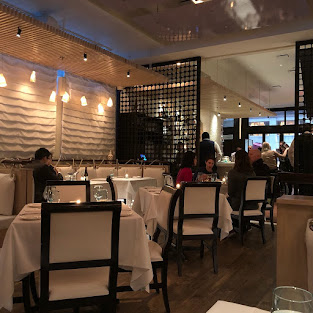
On a personal level, here’s what I miss: The ceremony of Going Out to Eat. A crowded restaurant, lots of chatter and laughter, clinks of forks and plates, maybe some cool jazz in the background. Talking with Z and friends. The maitre’d smiles warmly, genuinely happy to see us. He even remembers my name. Right on time, he shows us to our waiting table, slides my chair out for me. Maybe even unfolds the cloth napkin to lay in my lap. The white linen tablecloth, the place settings, the freshly poured glasses of water with ice - a fantasy realized. How can you exist this long without the satisfaction of a waiter handing out menus, asking, “Would you care for a drink?” Of course I would. “A vodka Gibson, please,” I say, “Straight up.” I even have my choice of vodka. “Ketel One,” I say confidently. And so it begins. The Ceremony of the Meal. A cast of impeccable characters: the waiter, the busboy (or bus person?), the wine expert with the opener around his neck. Maybe a friend stops by the table with a “How’ve you been?” And a handshake. (Remember those?) And the sounds. Oh
, those beautiful sounds. A symphony of conversation and laughs, and knives and forks on dishes, an energy carried by sound waves and delicious aromas that say you are in the right place, and heaven is here right now. 


Okay, I’m getting carried away. But I do miss the experience of “going out to eat.” It doesn’t have to be fancy. No wine steward, no “live” music. Just the staff, the food, and the waiter who asks what you want, confides in you that the snapper is to die for, asks how would you like your steak cooked, “I suggest medium rare,” and then asks the inevitable question after the main course: “Did we save room for dessert?” Who’s the “we” in this? Is the waiter going to join us? Finally the check, the credit cards, the chairs pushed away from the table, and a cheerful departure, stopping by a table on the way out to say hello to someone you haven’t seen in awhile. I heard that Giovanni’s Little Place, in Ladue, has shuttered. I am saddened, as though I have lost a dear friend. Fond memories, shared with Z. Many other places also gone. I wonder about those beautiful men and women who made going out to eat so special. Made me feel special. Where are they? How are they? They, too, are lost. 

Someday this classic ritual will return. But the faces and places, the names and ambience will be different. We’ll adjust to this new world. Our tables will be waiting. And it will be time to build new memories.

Sunday, August 30, 2020

A Funny Thing Happened on the Way to This Blog

A priest, a minister and a rabbi walk into a bar. The bartender looks at them and says, “What is this? Some kind of joke?” 

Rim shot.

What’s so funny? These days, not a lot. The virus, the shootings, the protests, the politicians all have arrived to create the perfect storm of anxiety. Yet the laughs keep coming. Take your choice of sources: sit-coms (old and new) movies on TV, stand-ups, streaming, websites, podcasts, apps. I find a lot on YouTube, some of the all time great routines and shows. Laughter persists for one reason: we need it. We need that balance in our lives, the bright release from the dark. It’s a special human gift. Researchers claim that some animals laugh - chimps, dogs, rats, dolphins. But they only react to physical stimulation, like playing and tickling. They’re unaware of punch lines, and haven’t evolved as far as “knock knock” jokes. 


Which brings me to Carl Reiner, who died this past July at the age of 98. That’s a lot of years and a lot of laughs for a whole lot of people. Carl became a comedy legend in many media, as writer, actor, performer and director. My favorite Reiner creations were The Dick Van Dyke Show and The 2000 Year-Old-Man albums with Mel Brooks. They are as funny now as when I first discovered them many years ago. Make that decades ago. Carl was the ultimate straight man who brought out the best in others. He and Mel remained friends until the very end.

The driving force behind that laughter was the writers. Today there are some incredibly talented comedy writers, with more outlets for their efforts than ever. But the seeds were planted, the formats and rhythms developed seventy years ago. I spent thirty years as a writer for ad agencies and was pretty good at it. But my soul wanted something else. To write comedy. Funny plays, movies, TV shows.


What I really wanted was to have been one of a special group of writers who wrote for Sid Caesar from 1950 to 1954. It was called “Your Show of Shows,” and starred Sid, Imogene Coca, Howie Morris and Carl. 

His stable of writers included men and women who tickled America’s funny bone. You’ve heard of some of them: Neil Simon. Larry Gelbart (Mash). Mel Tolkin (All in the Family). Danny Simon (Neil’s brother…what a funny family). Woody Allen. Selma Diamond, Joe Stein, Lucille Kallen. Among them they created some of America’s most memorable moments and shows, as well as a style of humor barely recognized at the time.

Sid, Carl, Imogene                                                                   


                                        Photo by Mark Seliger for Vanity Fair

In my more fanciful moments over the years, I’ve fantasized about sitting in Sid’s writers’ room, cup of coffee - black - in my hand; a half-finished poppy-seed bagel with a glob of cream cheese on a paper plate next to me; Bic pen poised over my notebook. Next to me sits Woody in wrinkled shirt and slacks. Across the table from me, Mel smokes a cigar, throws out hilarious lines. Neil just shakes his head. I don’t smoke but I might as well. The meeting begins, Carl at the head of the table. 

The dialogue: 

Carl Reiner: Listen up, guys. We need a closer here. 

Neil Simon: Where’s here? 

Carl: The restaurant, Neil. Sid and Imogene. Sid asks for frog legs. 

Larry Gelbart: That’s funny right there. 

Carl: Last line. Selma? 

Selma Diamond: “We’re out of legs. How about a couple of shoulders?” 

Carl: Not funny. Frogs don’t have shoulders. Anybody? 

Mel Brooks: “You want a pair of argyles with those legs?” 

Carl: C’mon, guys. Gerry. Whaddya got? 

Gerry: How about this? Sid asks the waiter, “Do you have frog legs?” The waiter says, “No, I walk this way because I’m chafed.” 

BIG LAUGH AROUND THE TABLE. 

Carl: Bingo. Thanks. Well done. 

My fantasy continues ad infinitum. I love the process, the people, the life of a comedy writer in New York in the early ’50’s. I go to the Carnegie with Mel and Carl. I go to the Village to hear jazz with Woody, Selma and Danny. Carl calls me and asks me to work on a TV sit-com he’s developing. Character’s name is Rob Petrie. I say “sure” and feel validated. I watch “Your Show of Shows” on TV and wait for my lines, my ideas, mingled with those giants of comedy, who are making America laugh. And I feel complete. 

Charlie Chaplin said, “A day without laughter is a day wasted.” 

Charlie was right.

Wednesday, July 1, 2020

Scooping the NY Times: Creativity Unbound and Damon Davis


The story you're about to read (I hope) first appeared in the recent issue of County Living Magazine. I had wanted to do an article about an African-American artist but had no connections to that culture. I contacted Dr. Gerald Early, who I know from the Jazz STL book club, and asked him for an idea. He immediately shot back a name: Damon Davis. I talked to Damon and knew this was my guy. Thankfully I have a publisher at CLM, Todd Abrams, who saw the promise in the article, as well as its timeliness and importance. Little did we know just how timely. This was weeks before the events in Minneapolis.


Here's the kicker: A story on filmmakers appeared today (Wednesday 7/1/20) on the front page of the New York Times Arts section. "Filmmakers With a Focus On Justice: Ava DuVernay, Stanley Nelson, Sabaah Folayan and Damon Davis discuss race and the documentary tradition." That's a heavy load to carry, but these folks are making it happen. 

The article. I don't have the layout available, and I can't download the photos, so I've included the copy I wrote, and then added photos of the magazine layout. Michael Kilfoy is the designer.

A thank you here to Damon, Sophie, Todd and Michael for this important addition to the St. Louis cultural scene.
                                    _____________________________


St. Louis is home to a highly original and multi-faceted artist who, as he says, has “a lot of tools in my tool box. I use the one that best tells the story I want to tell.” His name is Damon Davis and to try to put a label on him is an exercise in frustration. I’m used to classifying an artist by the medium he or she uses. Painter, sculptor, quilter, photographer. But for Damon, I am stymied. He is impossible to categorize, except to say “He is an artist.”

Classification, however, is not important. It’s his talent, his drive and imagination behind his media that makes the difference. Davis is an award-winning artist who works and lives in St. Louis, not far from the newly-emergent art district on Cherokee Street. His website refers to him as a “post-disciplinary artist.” I had no idea what that meant so I asked him. He said, “My practice is part therapy, part social commentary. I work across a spectrum of creative mediums to tell stories that range in topic and scope.” The purpose of his creative output is to give voice to the powerless and oppose systems of oppression. He is quick to remind me that he focuses on the joy as well as the pain of the Black experience. It’s that yin and yang that makes his website so appropriately named: HeartacheAndPaint.com.

Damon’s roots determined his journey through life. His mother was a sharecropper in Louisiana and moved to St. Louis during the 1960’s. His father, who was born in St. Louis, served in the Army during the Viet Nam war, but found returning to the U.S. difficult. Damon grew up in East St. Louis, and attended a Catholic high school in Belleville, Illinois. He received a full scholarship to St. Louis University, where he majored in Fine Arts but eventually graduated with a degree in Communications. 

“I was pushed in-between two separate worlds,” he says, referring to the the traditional world of commerce and the world of art. “My whole life has been art, it’s always been what I’ve done. I tell stories.” He talks about how many of his friends went into civil service. He was different. “For me, regular work was soul crushing. I wouldn’t be alive today if I had to do that.” He admits he doesn’t take orders well. The mark of a true artist.

Writing isn’t one of his strong suits. “I find writing difficult, but I’m working hard to improve it. People have approached me to write a book. I can talk, but my brain moves faster than my hand.” In the meantime, his visual art breaks new boundaries. 

Our conversation takes us to the subject of race. This stands at the center of his work. I asked Damon what he wants his art to accomplish. “I hope people will think, ask questions they didn’t ask themselves before, take a look at someone else’s experience. And arrive at an understanding.” He is quick to point out what it is not. “It’s not about getting past the legacy of slavery, not about getting past anything. It’s acknowledgment of America’s past.” That acknowledgment, he believes, can create a positive effect: “To bring people closer together; to make people realize they are not alone.” 

It seems no medium is unexplored for Damon. What is his favorite?
“Music,” he says after careful consideration. “What I love most of all is I can sit in a room with my equipment and create the songs and sounds and feelings I’m after.” He works on a keyboard and other electronic gear. “Music has put me in places with people who have completely different backgrounds. It’s as though we have a private conversation among us. I never would have known about them, except through music.”
His tastes include Miles, Stevie Wonder, Bob Marley, and many of today’s artists. His biggest influence is Outkast, one of the most respected hip-hop groups in history. His conceptual album, “Darker Gods,” delves into the power of myth, and provides the soundtrack to an exhibit of his. “It welcomes us to a new world of Black Gods and Goddesses.”  

Black Bagwas founded by Damon with Basil Kincaid, a nationally-recognized visual artist who lives in St. Louis. This award provides unrestricted funding, networking opportunities, and support for young black artists in St. Louis and East St. Louis. The cash funding ranges from $250 to $500, with guidance and supervision on a continuing basis.


Arising from the death of Damon’s mother, and his conflict with family and friends, “Cracks is a series of three-dimensional works that explore vulnerability, masculinity, grieving, and trauma. They were created as part of his residency at Grinnell College last year, and were featured in his solo exhibition at Grinnell’s Museum of Art. This was the kind of exhibit that stops you in your tracks and says, “Pay attention. This artist has something to say.” It was a combination of sculptures and digitally enhanced photographs.

An important and highly-praised documentary from 2017 was co-produced and co-directed by Damon, with Sabaah Folayan. A harsh and unrelenting look at the killing of Michael Brown, “Whose Streets” premiered at the Sundance Film Festival. The critics praised it, and The Guardian gave it a five-star review, calling it a “tremendous end run around mainstream news outlets.” Magnolia Pictures picked it up for national distribution in theaters. In 2016, he was named one of Filmmaker Magazine’s Twenty Five New Faces of Independent Film, and Independent Magazine's 10 Filmmakers to Watch.

Davis created a public art project on boarded-up storefronts in Ferguson in anticipation of unrest. Working with store owners, he wheat pasted the plywood-covered windows of participating stores with a series of posters developed from his photographs of “Hands Up.” Davis wanted to create "something visually appealing, to give people hope, and let them know we stand with them.” An original window board from the installation is part of the permanent collection at the National Museum of African-American History and Culture.

Ted Talk. August, 2017. The subject was fear. Damon shared his fear with a national audience on this highly-acclaimed program, an on-line service that streams talks on variety of subjects. “Fear is like a disease,” he said. “When it moves, it moves like wildfire. But when you do what you’ve got to do, it’s called courage. And courage, like fear, is contagious.” His talk was impressive and effective, showcasing his skill as a speaker and verbal communicator. One reviewer said, “Davis exhibits two impactful speaking skills here: showing emotion and using repetition.”

And finally, two more projects. The first, a graphic novel for children called “The Bull, The Boar, The Wasp, and the Ant.” Davis wrote and illustrated it in the tradition of countless West African proverbs. The other is “All Hands on Deck,” an exhibit of photographs by Damon of individuals in Ferguson. Organized by the Museum of Contemporary Art, San Diego, the “hands up” images became a national symbol .


At 35, Damon Davis has made an impact on the art world and America’s conscience. There is no telling what the years ahead hold for him. But we’ll find out. For more about him and his work, visit HeartacheAndPaint.com. Also watch the documentary “Whose Streets,” on line from various streaming sources.

Here is the NY Times today. Keep an eye on Damon. He brings a much needed vision to our American landscape.