Friday, May 17, 2013

Tomorrows in the Key of C


His name is Alex.
My reason for writing this is to ask you to do something important for him.

I first met Alex when he was 12 years old.
At the time I was host of a cable TV show called "Living Well." It ran weekly on HEC-TV. I think the total audience was 53. But the show gave me the opportunity to interview some rather interesting people, most of them seniors, because that's who the show was meant for.

So what was I doing interviewing a 12-year-old kid? Well, he was quite a kid.
Turns out Alex had a burning interest in World War II. It began when his dad took him to France and showed him the beaches at Normandy. Now Alex had made a hobby of collecting items associated with the war, even seeking out veterans. Not long after my meeting with him, Alex produced a documentary called "Six Heroes," a series of interviews with six men who had landed in Normandy on D-Day. It was an impressive effort, good enough to win him Best Documentary at the St. Louis International Film Festival that year.
Like I said, he was quite a kid.

I wish I could tell you this story has a happy ending. It doesn't.

Alex went on to better things, became a positive influence on many friends and younger people, went to college, gave his parents much pleasure. And some concerns. Alex had a tendency to drive too fast. And that's what ended part one of his story. As his parents said, "He was a meteor who shot across our skies."
That was a little more than three years ago. 

And now a new story has begun.
You see, his dad, Tom, has established Pianos for People as part of the Alex Townsend Memorial Foundation. Their mission is to put out-of-work pianos with young households, children's centers, shelters, the elderly, and everywhere that music should exist, but doesn't. 

Tom plays piano. I play piano. We both love jazz, blues, and the New Orleans stew of rhythms and harmonies. So music is one of the common bonds between us. When Tom told me about his Piano Project, I asked if I could help.
You're reading it.

I'm asking you to do a couple of things. First, if you have a piano you don't want anymore, or know somebody who does, contact the foundation. There are a lot of used pianos out there that go wanting for someone to appreciate them. Yes, pianos have souls. 

There's one more thing you can do. Pianos for People is a finalist for a grant from Monsanto. The money would help them refurbish more pianos and get them to more people. All you need to do is vote. You can do it once a day through this Monday, May 20th. Voting is not limited to just St. Louis. Wherever you live, you can vote. Here's the link:


Music has been a huge part of my life, from the time I began taking lessons at the age of 8 (yes, they had pianos back then, not just  harpsichords) until today, when I enjoy listening to Rachmaninoff's Second, Meade Lux Lewis' boogie, Peterson's songbooks, and Benny Green play with twenty fingers, or so it seems.

I know of Tom's love for music. I know what music can mean to help shape people's lives. Pianos for People is an inspired concept. Join the chorus.

That takes me to two quotes I'd like to leave you with. 
The first is by Plato.
“Music gives a soul to the universe, wings to the mind, flight to the imagination
and life to everything.” 

The second one is by Heinrich Heine. 
"Where words leave off, music begins."

Time to cue the music.

Tuesday, April 23, 2013

Listen To This


They call it "Inner Jazz." The subtitle is "Exploring the Landscape of the Soul Through the Transformative Spirit of Jazz." 

It's the Jazz thing that caught my eye. It's the Inner thing that promised to add a new dimension to the proceedings. Maybe I'm just looking for more meaning of life as the months pass all too rapidly. As Maggie Smith said, when asked how it felt to be 78, "Every meal is breakfast." The email came from Carol Beth True, superb jazz pianist, teacher and friend. She was going to be part of a jazz thing at Kirkwood United Church of Christ in Kirkwood. I made a note in my calendar. Five o'clock on a Sunday is usually wide open for me. That's four hours before Mad Men and Game of Thrones come on. And with DVR, it doesn't really matter anyway, except for the ritual. Probably a throwback to "the old days" when Thursday night was Star Trek Night, Tuesday night was Dick Van Dyke night, etc. Okay, I'll go back to Sunday night being Jack Benny night on the radio. Remember radio?


Sunday afternoon church is foreign to me. In fact, church anytime is. To say it's not even on my radar screen is an understatement. Still, the confluence of jazz and some sort of soul searching sounded appealing. I went. I listened. I let my thoughts wander. The music reached deep, starting off with "Equinox" by John Coltrane and some fine tenor sax work by Cliff Aerie. The program progressed with original tunes by him and fine solo work by Carol Beth and Cliff and Dave Troncoso on bass, Kevin Gianino contributing some very tasty work on drums. Plus a young vocalist named Arianna Aerie adding her sterling voice that delicately filled the church. The last tune was one of my favorites, "Afro Blue" by Mongo Santamaria.

There's something about "live" jazz in a church that I find very moving. Especially when coupled with a message about Our Earth. 

According to the Reverend Betsy Happel, this mingling of jazz and meditation will continue once a month. I'll probably be back there next month. A different jazz group will perform. But the spirit will be the same. The program they handed out contained several quotes, two of which I especially like and repeat here. 

John Muir: "When you tug at a single thing in nature, you find it attached to the rest of the world."
Buddha: "To live a pure unselfish life, one must count nothing as one's own in the midst of abundance." 

 Sometimes you just have to stop and listen.

Monday, March 11, 2013

The Writer I'm Going To Be


I thought I was a writer, until I heard Richard Ford speak last Friday night at the St. Louis County Library as part of their Read St. Louis Program. This, however, is not a review of the event. (I’m not a critic, though I tend to be critical at times. Ask my wife.) I’m just a guy who likes to write. I've written a few things, some of which I'm happy with, others that I can never get right, most of which I know can be better. Which leads me to often wonder what it must be like to spend time with a great writer, listen to him talk about his writing and mine, hear him read what he’s written, then apply it to what I’ve written or, better yet, what I could be writing.

I’ve never taken criticism easily, but if it were Ford, I would make an exception.

I sat with Peter Carlos. He was sitting on the aisle when I got there, empty chair next to him, and I knew I’d enjoy talking with him. In the half hour we had before Richard appeared, we talked about making movies and videos and writing and editing and teaching. He does all those things. The last time I saw Peter was when I participated in a video program called “Fade Up,” which he produces at Lindenwood. It was a conversation with Mike Wall about “Tillie’s Punctured Romance,” Charlie Chaplin and my novel.

So there we were, these two bearded guys talking creative stuff while waiting for this esteemed writer to enter the packed room, which was growing warmer by the minute. The place was electric with anticipation. I’ve been to other author events there, but this one seemed to achieve a higher level of excitement. After all, Ford has won the Pulitzer and the PEN-Faulkner award.


John Dalton, himself an excellent novelist, introduced Richard with well-chosen words. (How else would you introduce a great writer?) Richard came up to the mic, talked softly, very softly, to the point that the first short story he read was almost lost to the audience. Someone suggested he talk into the mic more directly, which he did after explaining that he talks softly, which we had all figured out, and he launched into a short story he had written some time ago, called “Reunion.” It had its roots in St. Louis and takes place in Grand Central Station in NY. Then he segued into the opening pages of his latest novel, “Canada.” I’ve read the book. Listening to him read that short segment made me want to read it again. A Q&A followed.

Here are a couple of things Mr. Ford said during the evening that struck home with me. He said every writer’s duty, during the course of his writing life, is to put everything down on paper that is important to him. That doesn’t mean opinions and self-focused thoughts, but the things in your life and your world that have meaning to you and you want to say something about. Someone asked him if he’d thought about writing a children’s book or a YA book (young adult). He essentially said “no.” He said it’s not what he’s good at, nor what he wants to write. It would be strictly a “show-offy” thing, as he called it. He knows his strengths and passions, and that’s where he wants to be. He writes every day for 4 hours in the morning and 2 hours after lunch. Every day! In a little shack/hut/cottage down the hill from his home in Maine on the edge of the water - either a lake or the ocean. Doesn’t really matter. 

Richard’s from Mississippi originally but said he doesn’t write about the South because so many others have done it better than he ever could. He mentioned Eudora Welty and William Faulkner and a couple of other writers, one of whom lived in his neighborhood. “In fact,” he said, “I wasn’t even the first one on my block to win the Pulitzer.” So he moved to Michigan, to get out of the South where his non-racist attitudes were at odds with his neighbors. 

Richard maintains a wonderful sense of humor, a strict writing discipline, and the ability to see deeply into people and relationships. I’m not very good at relationships; writing about them anyway. It takes effort. Lots of it. He’s able to capture in a few carefully chosen words what it can take me a paragraph to even get close to. One of the things I could have used along the way was a mentor. Someone who would look at my work and tell me how to improve it. It doesn’t come from open mic nights. It doesn’t happen with friends. Maybe it happens with on-line writing seminars, though I don’t believe it’s personal enough. It’s a long way from the ideal: a placid retreat amidst tall, stately trees and expansive stretches of lawn, a lake or the ocean within strolling distance, and a group of people interested in writing, brought together by men and women who “have done it” and can turn a piercing eye to my pages and pinpoint the excess, the vague, the missed opportunities, as well as the strengths, the occasionally sparkling phrase, the well-developed character. 

That muse calls to me now. “Gerry, move to Greenwich Village. Be 27 years old again, catch Basie at the Vanguard, write all night, drink espresso with unshaven guys and long-tressed women. Or find that cottage in Maine, just a stone’s throw from Richard’s hut or Stephen King’s house. Or maybe discover that cozy cottage near Carmel overlooking the Pacific that needs a caretaker in exchange for rent. There’s a place for you, somewhere a place for you.”

The voice is tempting. What I plan to do, in a more realistic frame of mind, is to buy a trailer and park it on the banks of the River Des Peres, facing west. I’ll have a stack of spiral notebooks and lots of pens and pencils. I’ll also have a laptop but no internet connection. I will escape from the demands of Facebook and Twitter and YouTube and Groupon, and deliver my written masterpieces by hand, in a binder, to an agent or publisher who has been eagerly anticipating their completion. Then, as I await the royalties and reviews, and movie offers from small, independent production companies, I will return to my trailer, pour a half-tumbler of Woodford Reserve, sit in my plaid folding chair and watch the sun set over the river while listening to Bill Evans play “If You Could See Me Now.”

Then I’ll raise my glass to Richard Ford.


Tuesday, February 19, 2013

Me and Mickey

I found this photo when I was digging through some old envelopes in the garage a couple days ago. There's a story behind this, one I haven't told many people and certainly one I had almost forgotten. Until now. 

The car is my 1956 Chevy Bel Air convertible. It was my first car. I was stationed in Pittsburgh at the time, a Special Services Officer, which meant I was in charge of getting teams together for tournaments, along with distributing ping pong balls we received from the Salvation Army, maintaining athletic facilities at the HQ as well as on the Nike missile sites. If our nation were ever attacked and the enemy descended on Pittsburgh, we could beat them in a ping-pong tournament for sure. Unless they were Chinese. A second lieutenant with a paddle in his hand, backed up by rugged men with wooden softball bats, badminton birdies, sharpened darts, and free passes for old movies was a deterrent not to be messed with. The word had evidently gotten out. We were never attacked.

Back to the car. On one particular winter weekend in 1958, the volleyball team and I travelled to Ft. Meade, Maryland for an important Army regional tournament. Major Theobald, our CO, had high hopes for us. We were big, we were fast, we were smart. I wore my dress greens, and kept my winter overcoat in the back "well," beneath the rear plastic window. I took three guys with me. The only one I remember is PFC Norm Mitchell, a scrawny guy from Tennessee who spit a lot, had a wicked laugh, used words and expressions I had never heard before, held military life in low esteem. Everyone called him Mitch, one of those naturally likeable guys. At the time I thought, someday I want to write a story or book about him. This is the closest I've ever come.

The other guy on the team I remember clearly was a big, black private whose name might have been James. Well over six feet, at least 200 pounds, not flabby. He was a natural born leader, but seemed interested only in leading others to the dark side. I followed him on that trip, to my embarrassment. Someday I'll remember his last name, then maybe I'll befriend him on Facebook. If he's still alive. Or not in solitary.

We got to Ft. Meade with no problem. We made it through the first three rounds looking sharp. The semi-finals were our next challenge. We won the first game easily, 21 to something in the low teens. Then the spirit left us. I don't know if we ran out of gas or got cocky or decided to screw Major Theobald, who nobody liked. The streak just ended. We lost the next two games.

"I know a good club," said James. "I know this town, got some friends there." 'This town' was Baltimore. We ended up in what I only remember as a street with lots of bars, broken sidewalks, dark alleys, shimmering neons with missing letters, and lots of people around. All ten of us - the entire team - followed James into a large bar with a juke box playing. This was 1958, remember, so it might have been some Wilson Pickett or Chuck Berry or "Rock Around the Clock," which had been out about 5 or 6 years. It sure wasn't Perry Como or Theresa Brewer. 

Our fearless leader was greeted like a returning hero, even though he had missed three spikes in that second game, which of course none of the folks at the bar knew or cared about. I remember sitting at the bar, being introduced to some of his friends, including the very pretty black lady tending bar. I was the fresh-face white second Looie in the very soul of Baltimore's night life district. I don't even remember asking for a drink. If I did, it would have been scotch, my choice of alcohol at the time. I've since developed a strong dislike for it, along with gin. The lovely barkeep with the emerging breasts and sparkling eyes set a drink in front of me. "You'll like this, honey." Most of the other guys had boiler makers: a shot of whiskey or vodka and a bottle of beer. We clicked glasses. "Here's to next year," someone said. "I hope not," I thought. I knew I'd be out in less than a year. I finished my drink while the bluesy guitar sunk into my head. And that's the last I remember.

I awoke - or came to - the next morning. Three of the guys from the team were there. I was in a bed. A strange bed, in a strange house or apartment. James was there, big, satisfied smile, as was Mitch, looking slightly hung over. "You feelin' better?" said Norm. "He needs coffee, and some flapjacks," said someone. A woman handed me a cup of coffee. The last time I had seen her she had handed me that magic drink. "Here you go, hon." I didn't touch the coffee.

So they made a fuss over me, making sure "the lieutenant feels okay" after eating something bad and getting sick and passing out. All I had was that drink and I knew how that went down. I washed up and said it was time to head back to Pittsburgh. Somehow my car had turned up outside the house. The weather was freezing, the smell of snow in the air. I hurried out to the car and saw the back window had been slashed. I opened the door. My overcoat was gone. Nobody knew anything. 

It was a long drive back to Pittsburgh. And it was my last volleyball tournament in uniform.

About two weeks later, Mitch came up to me outside the radar van on the Nike site. He had this small grin on his face, tempered with his attempt at apology. He threw me a casual salute. "Lieutenant, I feel bad about what happened over there. I'd like to help pay for the window." He tried to hand me some folded up greenbacks. I told him I didn't want his money, just an answer. "It was a mickey in my drink, right?" He nodded. "James set it up?" He looked down at his feet. "I don't really know, sir. He likes you a lot. Me? I think he did. But I don't know for sure. He didn't say nothing to any of us. Swear to God."

Like I said, I liked Mitch. I believed him. I didn't mind losing the overcoat. It was just an overcoat. But it sure hurt to see my Chevy cut like that. Happy ending: the insurance company paid for the whole thing, no deductible. A favor to a man in uniform.

                          Here's how the car looked on a better day.


Sunday, February 10, 2013

"Stranger in a Stranger Land"


That’s the title of a famous Robert Heinlein science-fiction book. It’s also the way I feel as I get ready to watch the Grammy’s tonight. I won’t actually watch it all, start to finish. I’m going to DVR it. That’ll save me a lot of time and irritation. But I would like to know something about the State of Music these days.

When I was Creative Director on Budweiser, we did a lot of radio spots using recognized artists. Trouble was, I didn’t recognize half of them. And this was back in the mid-80’s. For instance, in 1988 we did Bud spots with The Nylons, Squeeze, Beat Farmers, Dave Edmunds, Ricky Van Shelton, Outloud, Jamaica Boys, Wilson Pickett. And a few others. I knew Dave and Wilson. Fortunately I had young guys in my group who knew what was going on. 

I looked at the list of nominees for this year’s Grammy’s. “Who are these people?” I wondered. Here’s an example. Fun. is one of them. No, that period isn’t a typo. It’s “Fun” with a “.” at the end. Must mean something, I’m sure. Then there’s Mumford and Sons. Very big, I know. But I have no idea what they sound like. Or how many sons there are. Or who or what Mumford is. To me it sounds like a spin-off of an old Red Foxx TV show. 

Then there are the nominees for “Best New Artist.” They are The Alabama Shakes, Fun., Hunter Hayes, The Lumineers, and Frank Ocean. I never heard any of them sing or play or shake or whatever they do. There are, however, some names I’ll know. Taylor Swift, Bruce Springstseen, Adele, Rihanna, Beyonce. Which makes me wonder: What is it with these one-named people? I don’t know when that all began. Maybe with Prince? Or maybe with Liberace. Now there was a musician for you, white piano and all. 

Other single-name nominees are Miguel, Usher, Estelle, Tamia, and Nas. I assume these are people, not groups, but who knows? I will, after tonight. I know the name Megadeth but the concept creeps me out. I also know Tom Waits and used to like him, don’t know what he’s doing now. I’m sure his voice hasn’t smoothed out.

Tell you the truth, the only category I’m comfortable with is Jazz. Those are real people, first and last names. Chick Corea, Gary Burton, Ahmad Jamal (yes, he’s still alive and recording, obviously), Pat Metheny, Bob Mintzer, Arturo Sandoval, Lluciana Souza, Bobby Sanabria (good latin big band jazz), Brad Mehldau. We’re well past the time of Monk, Prez, Bird, Miles, Duke. But they all had two names. These were nicknames.

I like what Lou Reed said about jazz. “If it has more than three chords, it’s jazz.” Also like Miles’ comment: “Do not fear mistakes. There are none.”

I’m sure jazz won’t get much air time tonight. The name of the game is ratings. Still, I’ll be watching and listening, remote in hand, thumb on the “fast forward” button, trying to soak up as much of today’s musical culture as possible, before moving on to “Downton Abbey” and “Justified.” 

Here’s a link to the Grammy nominations. Be careful, though. You might just end up a “Stranger in a Strange Land.”  But that’s cool. 2013 Grammy Nominations

Monday, January 21, 2013

A Wondrous Time for Baseball

Frequently what is passed off as a coincidence may have deeper roots than that. Believe it or not, I started writing this post last week. Then on Saturday night, as my son and I ate dinner at the Corner Pub and Grill, he looked at his smartphone and said casually, "Stan Musial died." And so another one of our heroes is gone, and a chapter in my life is complete. 

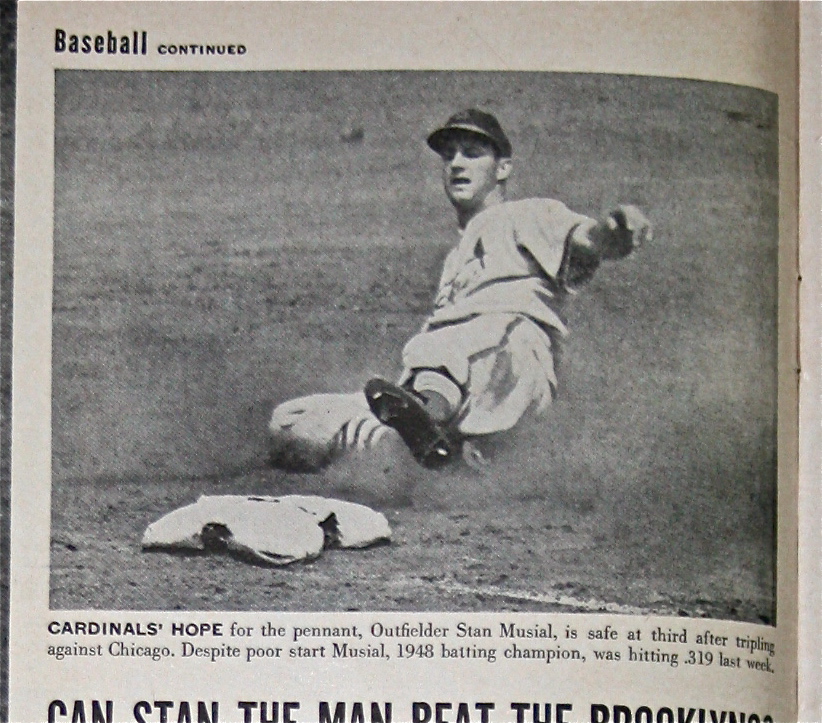
But this is not a memorial for Stan I write. It is a look back to 1949, because I happened to come across an old Life Magazine while looking for an article on Charlie Chaplin and saw this.

The pennant race between the Cards and the Dodgers was in the home stretch. For the very young, a pennant race was just that, two teams battling it out to see who plays in the World Series. "Play-offs" and "Wild Cards" were as yet undreamed of. And in this year, 4 years following the end of World War II (good guys and bad guys clearly defined),  Life Magazine ran a story on that: "Yanks or Red Sox? Cards or Dodgers?" 
This pictures the two best second basemen in the game: Jackie Robinson and Red Schoendienst. Unfortunately Red fell down while trying to catch a wild throw from the catcher and Jackie went to third. It would be several years before the Cardinals put a black man on their roster.

But the line I like best is "Can Stan the Man Beat the Brooklyns?"
The article says, "The principal reason the Dodgers are worried about the Cardinals is Stan the Man Musial. Although Musial has been having only a fair season (for him), Dodger pitchers cannot seem to get him out." 
I love this photo of Stan because he is not up at bat in that familiar stance. He's sliding. The caption reads, "Cardinals hope for the pennant, Outfielder Stan Musial is safe at third after tripling against Chicago. Despite a poor start Musial, 1948 batting champion, was hitting .319 last week." Yep, Stan had turned a double into a triple with his customary hustle.
Since his passing, the newspapers and the networks and the blogs and the columnists have just about used up all the appropriate adjectives and phrases that describe Stan's achievements, his life, his demeanor, his selflessness. I have memories of Stan, as we all do. Not just at Sportsman's Park, but a night I spent with him and Henry Ruggieri and Joe Gargiola in San Francisco in 1960, when I lived there and they were in S.F. for the opening of Candlestick Park. I have an autographed baseball, an autographed book, a menu from Musial and Biggies. I used to have a Bowman's black and white baseball card of Stan, but my mother threw them away when I was in the Army and they moved. (Get over it, Gerry) Those, along with my EC Comics (seriously, get over it). 

Sometimes I think I'd like to be 25 or 30 years old again, be around for whatever tomorrow brings. But I'm not so sure these days. And I sure am happy I didn't miss the pure excitement of watching the Cardinals take the field, with number 6 in the lineup, and anticipate what he might do that day. He and Slaughter and Schoendienst and Kurowski and Breechen and the others.

I followed the standings, watched Stan's batting average climb up through the 300's, his home run totals move to the top of the list, loved his easy way of coming through in the clutch to win a game with a long ball and watch his easy stride around the bases. No big deal, no fists pumped in the air. It was just his job, to play the best he could. And he always did. I didn't know it at the time, but when the Cards finally got around to adding black players to the roster, Stan was the one who welcomed them, in a city that had more trouble adjusting to the new reality. 

I'll always carry those thrilling memories of Stan the Man. He was a part of my life and love of baseball. As long as there is someone to announce, "Play ball," Stan will be out there, a singular example of what a ballplayer, an athlete and a man should be.


Friday, January 4, 2013

My Next "Big Thing"

Esteemed author, philosopher and literary outlaw Dennis Fleming (see photo) invited me to join in on this remarkable concept for authors. If you want to see how he writes, what he writes, you can find out
here. http://www.dpressingnews.blogspot.com/

Enough backstory. Here's what I have been writing or at least trying to.

First, I have a new play that opens on Friday, Jan. 11, and runs for 2 weekends. It's produced by First Run Theatre. Performances are Fridays 1/11 and 1/18 at 8 pm; Saturdays 1/12 and 1/19 at 8 pm; and Sundays 1/13 and 1/20 at 2 pm. It's a one-act, and I am blown away by what the director Donna Nelson and the cast have brought to my words. The title is "Open Sundays, All Makes Repaired," and it's paired with another one-act, "The Predicament." The theater is at DeSmet High School on Ballas Road.  Here's a link: First Run Theatre

Second, my novel, which was published two years ago, still finds readers and has introduced me to a legion of Charlie Chaplin fans. The title is "Shadow and Substance: My Time with Charlie Chaplin," and it takes place in Hollywood, today and during the 1930's. And, yes, Charlie is in it. I have been fascinated by his life and films for many years, so writing the novel was really an act of passion. But then I guess all writing is based on that, isn't it? Here's a link to that. 

Onward to the 10 Questions:

1) What is the title of your new book?

The working title is "The Eulogy Club." It may well be the final title, because I like that combination of words and the curiosity it creates.

2) Where did the idea come from for the book?

A combination of two events: 1) I attended a memorial service for a friend; 
2) I had lunch with three long-time friends a week later. At lunch we talked about the same stuff we've talked about for years: politics, food, travel, health, movies. After lunch I decided to drive through Forest Park, it being a soft, magical spring day. I stopped by one of the fountains, got out and began to wander around. My friend who had died loved to bike ride in the park. I thought about him, and the feelings that were expressed at his service, words he never heard. I thought about my lunch, about feelings that were never expressed. That's when the idea hit me. Not as a book at first, but as something to do with my friends. A get-together where we would tell each other what usually is said only after death. That quickly morphed into an idea for a novel. The title was right in front of me. "The Eulogy Club." I started making notes that night.

3) What genre does the book fall under?

I've never been much good at genres. Probably nothing more than a novel. Dramatic. Touching. Humorous. Tragic? I don't know yet. Instructive? I don't know yet. Let's just say Fiction for Adults (but not Adult Fiction, because that sounds like one step removed from Porno.)

4) Which actors would you choose to play your characters in a movie rendition?

It's too soon to say. The characters have not been fully fleshed out yet. If I want the movie to be a big hit, I'd cast George Clooney, Russell Crowe, Sean Penn and Christopher Walken. The characters are in their early 60's, which seems a good time to speak of death and treasure friendship. So a quick pick would include DeNiro, Walken, Jeff Bridges, Dustin Hoffman. 

5) What is the one sentence synopsis of your book?

Sometimes the things we think we should say to someone while they're still around shouldn't be said at all.


6) Is your book self-published or represented by an agency?

Of course I'd rather have an agency involved, but that takes such a long time and so much work, and I don't have enough time or energy to wait around for that. So probably self-publish. But that's a long way away. First I have to write it. 

7) How long did it take you to write the first draft?

No comment. I'm planning by the end of 2013. My novel, "Shadow and Substance," took three years to write the first draft. I was working full time in the creative department of an ad agency and struggled to find the time and energy to keep writing on the novel. It actually spent more time on the shelf than in creation. 

8) What other books would you compare this story to within your genre?

No titles come to mind. Any novel that explores friendship in all its permutations, the sense of time running out, the fear of being vulnerable, the advantages and drawbacks of honesty. Sounds like a Russian novel to me.

9) Who or what inspired you to write this book?

 Early on, I bounced the idea off a couple of literary friends. Their reactions were identical: "Wow." Then I read 3 or 4 pages, possibly the opening of the novel, at a St. Louis Writers Guild open mic night last year. Highly positive reaction. Further inspiration comes from a small business I have. It's called The Life Preserver. I make video biographies of people, usually for their kids or grandkids. It's a legacy kind of thing. Older people have this need to say things that they omitted in previous years. Important things that usually fall into the category of "they already know how I feel about them." Which is why I frequently ask, "Did you ever tell your kids you love them?" And the final statement: "What else would you like to say?" 

10) What else about your book might pique the reader's interest?

I've thought about an Author's Note to the effect - How to say the things you should say to a friend and still keep them as a friend. Something like that. But I don't see the book being a "how to" book. It's just possible that things will go awry in the novel, friendships will be damaged, perhaps beyond repair. Maybe I'll write a blog about Friendship and Eulogies and Memorial Services for the Living. Or maybe I'll have a priest, a minister and a rabbi write testimonials. Which leads to, "A priest, a minister and a rabbi walk into a bar. The bartender says 'What's that book you have there.?' The priest says, 'It will introduce you to Jesus.' The minister says, 'It will give you eternal peace.' The rabbi says, 'It costs only seven dollars, plus shipping.'" Something like that.

Now about the 5 Writers I'm Tagging:

1) Jean Whatley. Remarkable with words, powerful means of expression, highly personal observations, a delight to read. She has just had her first book published, a memoir of the road. It's called "Off the Leash." Here's a link to her blog: http://jeanellenwhatley.com/blog/

2) Peter Green. Knowledgeable author about World War II, crime, and other compelling subjects. http://www.peterhgreen.com/

3) T.W.Fendley. Award-winning sci-fi author who specializes historical fantasy. Here's her intriguing website. http://twfendley.com/

4) Linda O'Connell. She must be published in just every publication out there, has won numerous awards, has a lock on human-interest stories, and a marvelous sense of humor. http://lindaoconnell.blogspot.com/

5) Dwight Bitikofer. A highly original poet who works well in a jazz environment. Winner of awards; several summers at U. of Iowa. Here's his Facebook page. Dwight the Poet